
Purpose and scope
Valxel SDLC is an agentic software development lifecycle. It takes a product from a vision to a roadmap, takes each feature from an idea to production, and handles production incidents. Agents do the work, and people decide at gates. The goal is that people spend about 15% of the effort and agents 85%.
This page describes the tool as built in valxel-platform/agentic-sdlc. Teams run it themselves, in their own environment and on their own cloud: AWS, Google Cloud or Azure. The README has the detail for each part.
Who uses it
- Founders and product owners describe a product or a feature, and approve the brief, the roadmap, the spec (G0–G2) and production goals.
- Designers and architects approve the design (G3) and the architecture (G4), or take a phase over.
- Engineers and security reviewers approve high-risk changes (G5) and see what agents built.
- Release managers approve production and the rollout plan (G6).
- On-call is paged only when the tool can't resolve an incident itself.
Design principles
- Agents work, people decide. Gates G0–G6 wait for approvers named in the product's governance repo. Three failed evaluator loops, or a spent budget, hand a phase to a person.
- Products own their rules. The tool keeps no product settings. It reads each product's governance repo and pins it by commit for the life of a feature. Products can tighten the platform's rules, never loosen them.
- Production stays human. Promotion is a person's decision at G6. The tool may act alone only to turn off a recent flag or roll back a recent release, when the policy allows it and the analysis agrees.
- The data class picks the model. The model gateway routes health and payments work only to providers covered for it.
- Every integration is an interface. Configuration decides what each one reaches: the real system in live mode, or the offline mode, in which the whole pipeline runs deterministically for evaluation and tests.
- Layers only point down. The root wires four seams (intake, delivery, the roadmap and operations); each seam uses only itself and the shared core, and a test fails on any import that breaks this.
- Agents hold no keys. Agent sessions run sandboxed, with no GitHub token, cloud credentials or model key; they reach only the LLM gateway and the egress proxy.
- Everything leaves a record: decisions, production changes, model calls, cost and traces, for audit and for learning.
System context
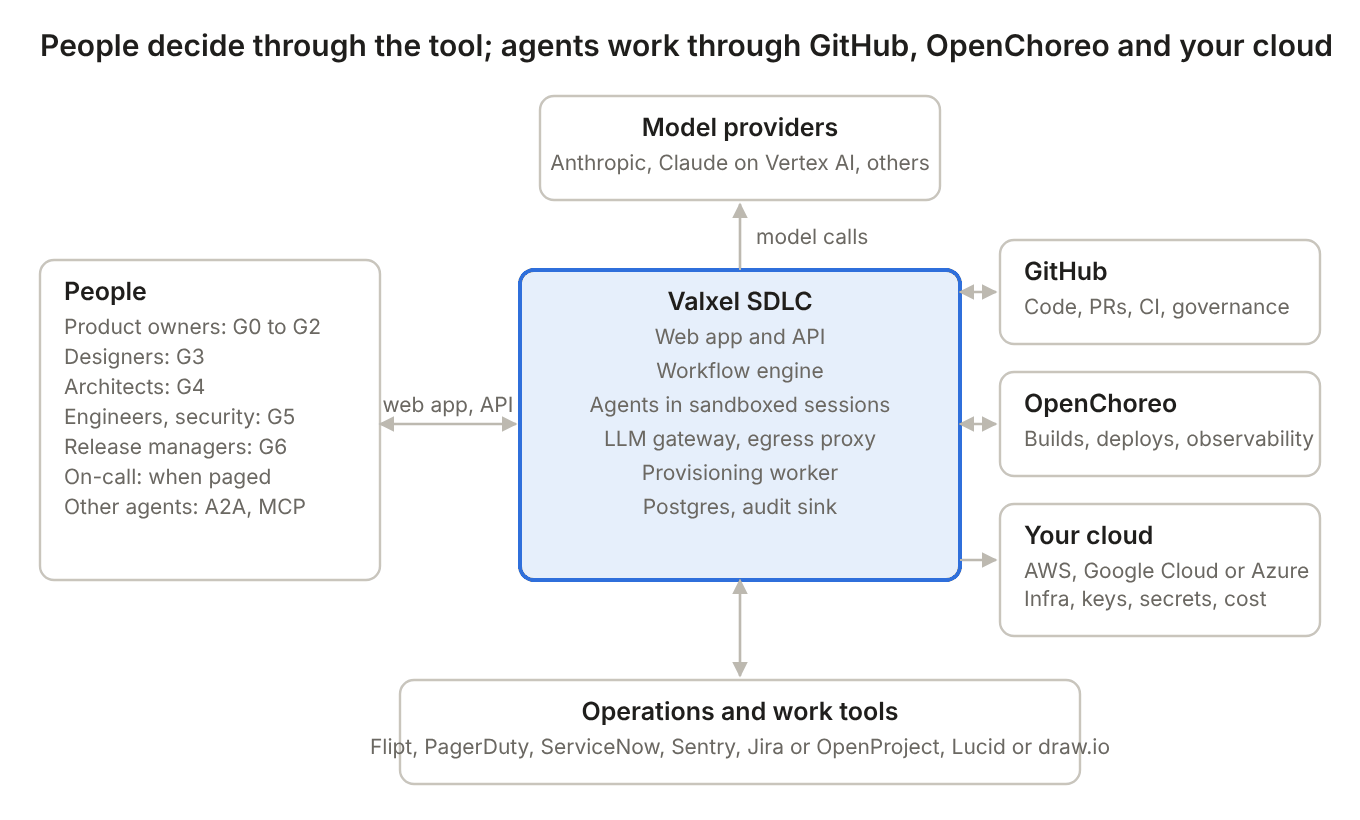
People reach the tool through its web app and the API behind it; other agents reach it over A2A and MCP. Sign-in is GitHub, Cognito, Google Workspace, Entra ID or any OIDC provider. The tool reaches everything else through an interface per system:
- GitHub: product code, pull requests and CI, plus each org's governance repo, read through a GitHub App. Webhooks tell the tool when CI finishes or a pull request changes.
- OpenChoreo, the internal developer platform: it builds images, deploys them to each product's environments, and runs the observability plane. Production signals come back from it and from error tracking.
- Your cloud, one per installation (AWS, Google Cloud or Azure): each product's infrastructure (Kubernetes clusters, managed databases), plus the tool's own signing keys, secrets, immutable archives, cost data and budget alerts. The core reaches it only through ports, with an adapter per cloud.
- Model providers, only through the tool's model gateway, which applies the data-class rules, and its LLM gateway, which holds the model key.
- Operations and work tools: feature flags (Flipt), paging (PagerDuty), change records (ServiceNow), error tracking (Sentry or GlitchTip), work tracking (Jira or OpenProject) and diagrams (Lucid or draw.io).
Architecture
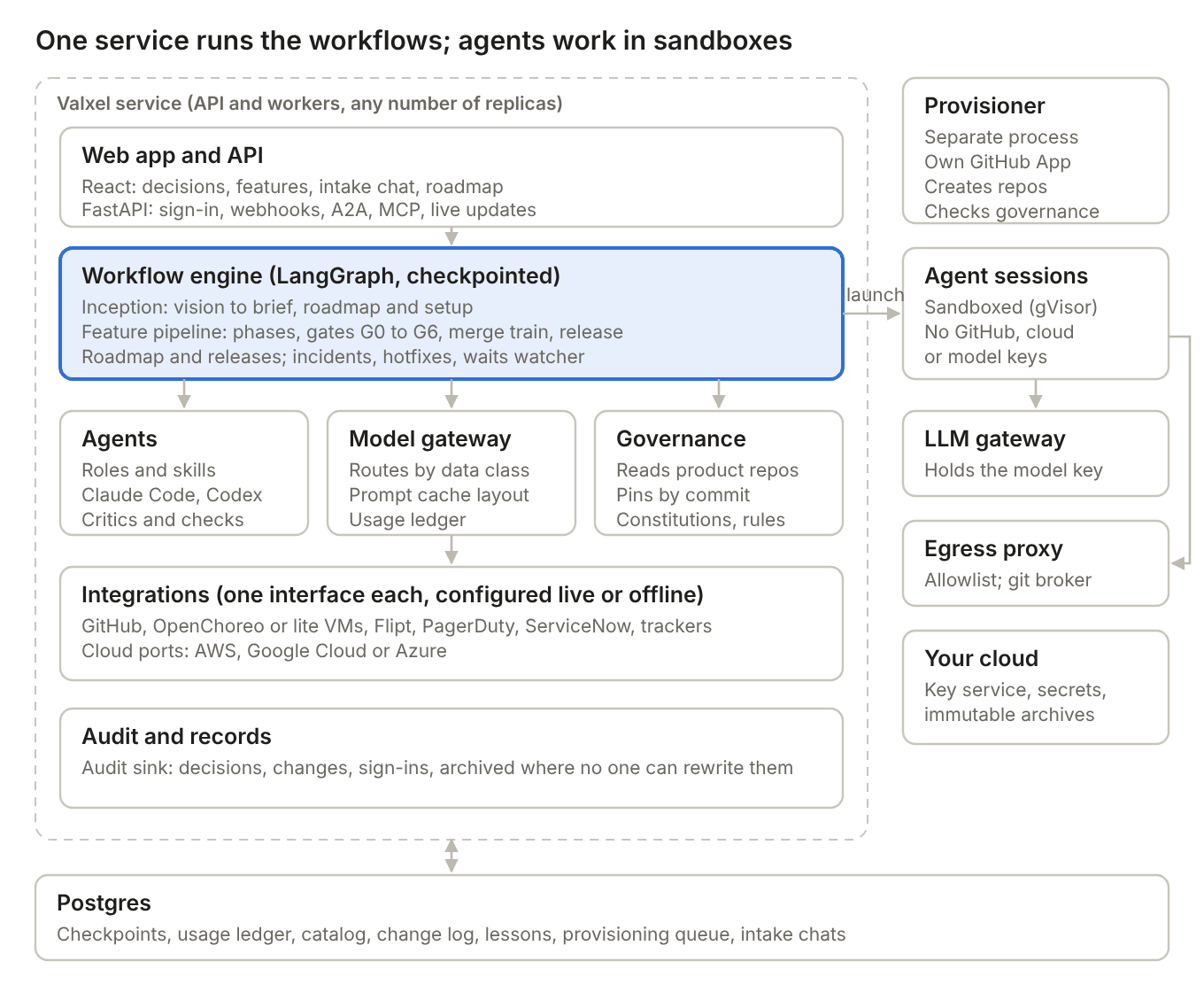
The tool is one Python service and one Postgres database, plus a small provisioning worker. Every workflow is a LangGraph graph. Each step is checkpointed in Postgres, so a feature can wait days at a gate, or on CI or a deploy, and resume after a restart. Several replicas can run side by side: an advisory lock per thread keeps one replica on a feature at a time, an elected watcher checks external waits, and live updates go through Postgres NOTIFY.
The provisioning worker is the same image run as valxel provisioner, in its own process with its own cloud identity. It is the only process that can sign for the GitHub App with administration rights.
Agents work in sessions the session launcher starts: sandboxed containers or pods (gVisor), one per task, with no GitHub token, cloud credentials or model key. A session reaches models only through the LLM gateway, which holds the model key, and the network only through the egress proxy, whose git broker lets it push to its own repo and nowhere else. Every decision and production change also goes to the audit sink, which archives it where no one can rewrite it.
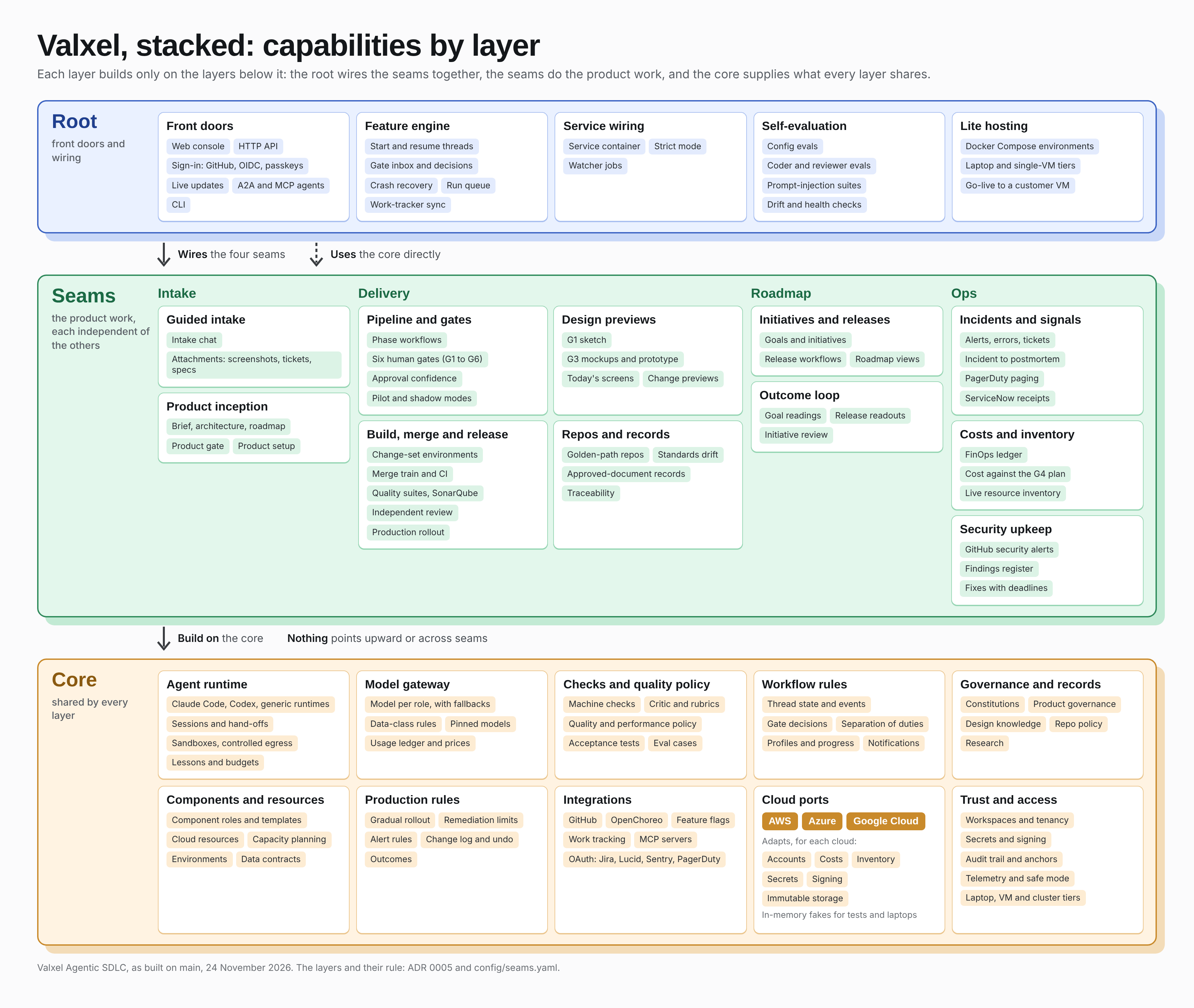
How the code is layered: the root (the front doors and the wiring) builds on four seams, and the seams on a shared core. The capability layers show what each layer does, and the module map shows every module and how they import each other.
How a request moves through it: a person acts in the web app; the API records the decision and resumes the waiting graph; the graph runs agents through the gateway and acts through the integrations. When it has to wait (for a person, CI, a deploy or the worker), it checkpoints and stops. Webhooks and the waits watcher wake it again.
Product inception: from a vision to a set-up product
A new product starts as an inception thread (INCEPTION-PRD-<n>). Both of its gates belong to the product council, named in the registry (inception.council). The product doesn't exist in the registry until setup's pull requests merge.
- Research. It runs once and covers the market, competitors and users. The brief cites it, and the brief gate shows it.
- Brief. Agents draft the product brief: id, org, users, goals with measures, data class, budget and capacity tier.
- Brief gate. The council approves, sends the brief back with feedback, or drops it.
- Plan. Agents draft the architecture, then the roadmap. The architecture includes the deployment diagram, the flows as sequence diagrams, and a capacity and cost plan per stage; its diagrams are published to Lucid or draw.io for reviewers. The roadmap sets goals, initiatives and releases.
- Product gate. The council approves the architecture and roadmap together, sends them back, or drops the product.
- Setup, each step recorded and safe to repeat:
- Governance repo: created through the provisioning worker. Its pull request carries
product.yaml, the constitution, context, goals, initiatives and the capacity plan. - Registry: a pull request adds the product to
config/registry.yamlin the config repo. - Environments, full mode: a pull request for the product's two clusters, then its OpenChoreo project, environments and pipeline once both data planes register.
- Environments, lite mode: dev, staging and production as Docker Compose projects on one or two VMs the team provides. No clusters.
- Approver teams: listed for an org admin to create.
- Governance repo: created through the provisioning worker. Its pull request carries
From then on, the product's governance repo is the source of truth. Features start from the roadmap's initiatives (G0) or from the intake chat.
Feature lifecycle
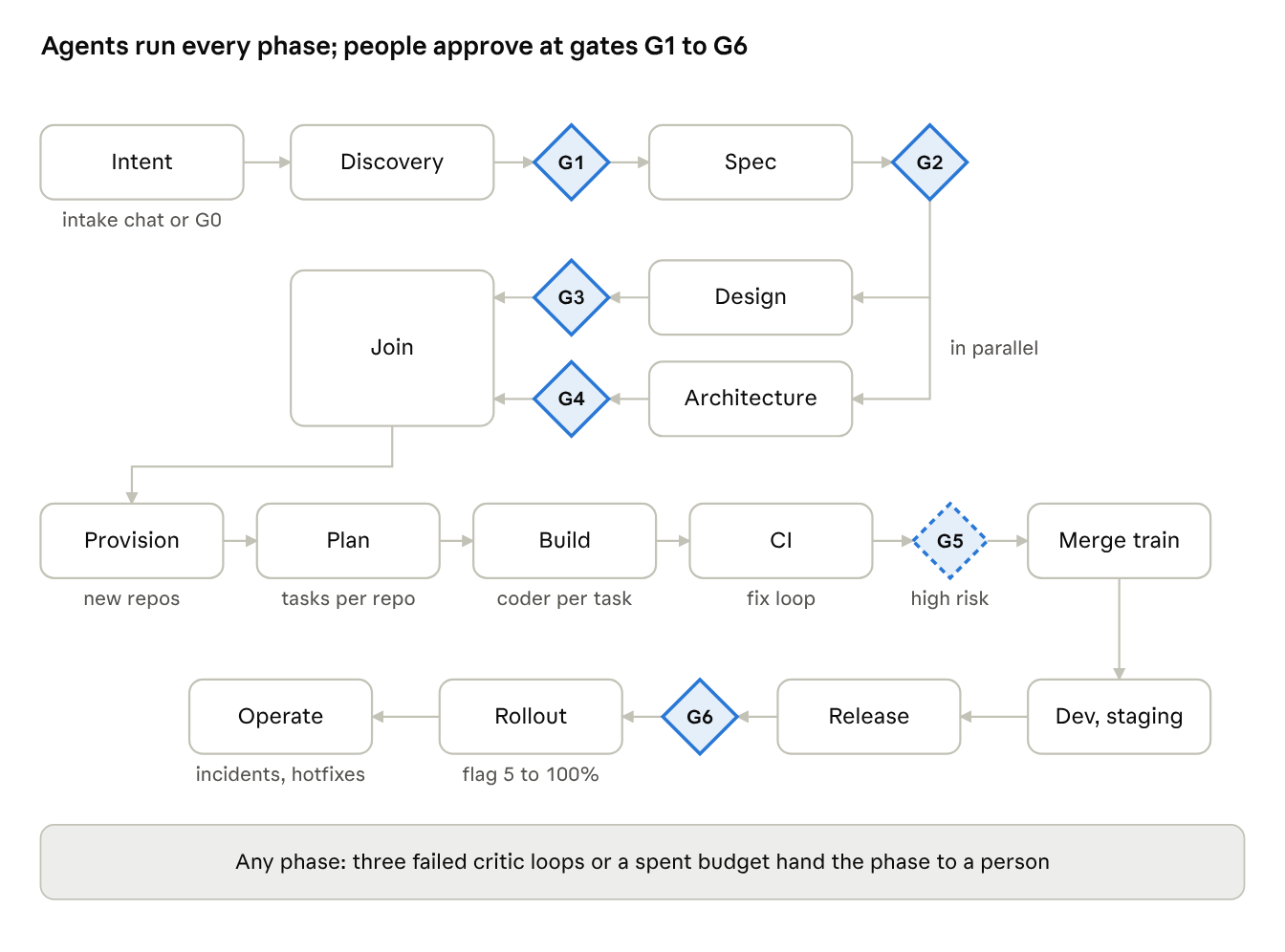
One feature is one thread, across every repo it touches. Each phase is a subgraph: an agent produces, deterministic checks run, then a critic in a fresh context scores the work against a checklist, and the phase loops until it passes or escalates.
| Gate | Who decides | What they approve |
|---|---|---|
| G0 | Product owners | An initiative from the roadmap becomes a feature |
| G1 | Product owners | Discovery: the problem, users and measure |
| G2 | Product owners | The spec and acceptance criteria |
| G3 | Designers | The design (decided as a pair with G4) |
| G4 | Architects | The architecture, new repos and resources |
| G5 | Engineers, security | High-risk or regulated changes only |
| G6 | Release managers | Production and the rollout plan |
At each gate a person can approve, send it back with feedback, take the phase over (their version becomes the document), or stop the feature. Every decision records who, when and how many active minutes, which is how the tool measures the 15% human share. For small, low-risk changes, the express profile skips discovery and UX design: G4 approves the spec with the architecture, while architecture, G5 for risky changes and G6 always stay. Products opt in, and express never applies to health or payments products.
After G4, the provision step creates any new repos through the provisioning worker. The planner splits work into tasks, with one coder agent per task and one reviewer per pull request. An independent review agent can also review every product pull request; it is off until a team switches it on. Failures in CI, the build, dev or staging go back to the coders of the repos they point at. The merge train merges libraries first, then providers, then consumers. OpenChoreo deploys to dev and staging, and after G6 the flag steps through 5, 25, 50 and 100%. It holds on nearby incidents, and stops if users with the flag on fail more than users without it.
Components
All paths are under src/valxel_sdlc/.
| Component | Where | Responsibility |
|---|---|---|
| Web app and API | web/ (React), api/app.py (FastAPI) | Decisions, features, intake chat, roadmap; sign-in; GitHub, Sentry and production-signal webhooks; live updates over server-sent events |
| Sign-in | web/auth.py, web/identity.py | GitHub, Cognito, Google Workspace, Entra ID or any OIDC provider; revocable sessions; matching people to the approver teams or identity-provider groups in each product's governance |
| Engine | engine.py, waits.py, cluster.py | Starts features, lists the inbox, applies decisions; resumes threads when CI, builds, deploys or the worker finish; one replica per thread |
| Feature pipeline | graph/pipeline.py, graph/phase.py | Phases, gates and escalations; parallel design and architecture; build fan-out; merge train; release and rollout |
| Inception | inception/ | Research, brief, architecture and roadmap, the two council gates, and product setup |
| Roadmap | roadmap/ | Goals, initiatives (G0) and releases |
| Agents | agents/, runtime/, agent_calls.py | Roles and plugin skills per phase; Claude Code, Codex and generic runtimes; one coder per task, one reviewer per pull request |
| Agent sessions | session_launcher.py, sandbox.py, egress_proxy.py, git_broker.py | Sandboxed sessions with no keys; the egress allowlist; git pushes only to the session's own repo |
| Evaluators | evaluators/ | Deterministic checks first, then a checklist critic in a fresh context, with its quotes checked against the document |
| Model gateway | gateway/ | Role-to-model registry, data-class allowlist, cache-first prompt layout, usage ledger |
| Governance | governance/ | Reads each product's governance repo and the platform's, validates product.yaml, pins both by commit per feature |
| Provisioning | provisioning.py, provision_queue.py | New repos from templates with the platform's standards; the queue and the provisioning worker's checks |
| Delivery | integrations/github.py, integrations/openchoreo.py, lite/ | Pull requests, CI and merges; builds, environments, promotion and rollback through OpenChoreo, or through Docker Compose on a VM in lite mode |
| Operations | ops/ | Production signals, incidents, correlation with recent changes, remediation policy, paging, ServiceNow, change log, resource inventory |
| Cost | finops/, gateway/ledger.py | Model spend per feature and phase; production cost per feature from FinOps |
| Knowledge | knowledge/, duplicates.py | The architecture record, API contracts, design checks, and finding requests the product already has |
| Quality | quality/, performance.py, acceptance.py | Test and security suites and their floors per data class; performance budgets; acceptance tests across repos |
| Secrets, signing and audit | secret_ring.py, signing.py, audit_events.py, audit_anchors.py, strict.py | Secret stores and key rings for rotation, signing for the GitHub Apps in your cloud's key service, the audit trail and its anchors, and refusing an unsafe production start |
| Cloud ports | cloud/ | What the core needs from a cloud (secrets, signing, immutable archives, identity, accounts, cost, inventory, signals), with adapters for AWS, Google Cloud and Azure and in-memory fakes |
| Security upkeep | upkeep/ | GitHub security alerts into one findings register, triaged into a hotfix or a release with a deadline |
Data and state
The tool keeps as little as it can, and nothing that belongs to a product. Products' rules, plans and records live in their own Git repos; the tool's database holds what it needs to run and to account for its work.
| Data | Where | Kept for |
|---|---|---|
| Workflow state: every feature, inception and incident thread, step by step | Postgres (LangGraph checkpoints) | Resuming after restarts; the feature's history |
| Gate decisions: who, when, active minutes, feedback | In the thread state | Audit; measuring the human share |
| Usage ledger: one row per model call (role, model, tokens, cache, cost) | Postgres | Cost per feature and phase; cache-hit rate |
| Change log: every production change, hash-chained | Postgres, plus a ServiceNow receipt where used | Change management; looking back after incidents |
| Capability catalog, lessons, intake chats, provisioning queue | Postgres | Reuse, learning from corrections, the worker's queue |
Product governance: product.yaml, constitution, goals, initiatives, capacity, ADRs, postmortems | Each product's governance repo | The product's own rules; pinned per feature by commit |
| Platform rules: constitutions, templates, quality floors, model routing | The tools org's config repos | Rules every product inherits |
| Documents agents write (PRD, design, HLD, plans) | Artifacts, linked from the thread; ADRs and records go to Git | Review at gates; the product's knowledge |
| Lite mode runtime state | One JSON document beside the tool's data | What runs on each VM |
| Audit trail: decisions, production changes, sign-ins | The audit sink, archived in immutable storage, with hash-chain anchors | Proof no one, the tool's operators included, rewrote the record |
| Agents' notes and eval cases | Postgres; code kept only as short excerpts; eval cases pruned on a schedule | Learning and replaying agents, without keeping customer code |
| Secrets | Your cloud's secret store, or mounted files; GitHub App keys in its key service, sign-only | Never in the database or the code |
Events into the tool: GitHub webhooks (CI, pull requests), production signals (Alertmanager, error tracking, tickets, cloud alarms and budgets, GitHub security alerts) and people's decisions. Events out: pull requests and merges, deploys, flag changes, pages, change records and live updates to the web app.
Products themselves follow constitution VX-16: they change state Kafka first, and event workers keep each data store from those events, so any store can be rebuilt by replaying its topics.
Runtime and deployment
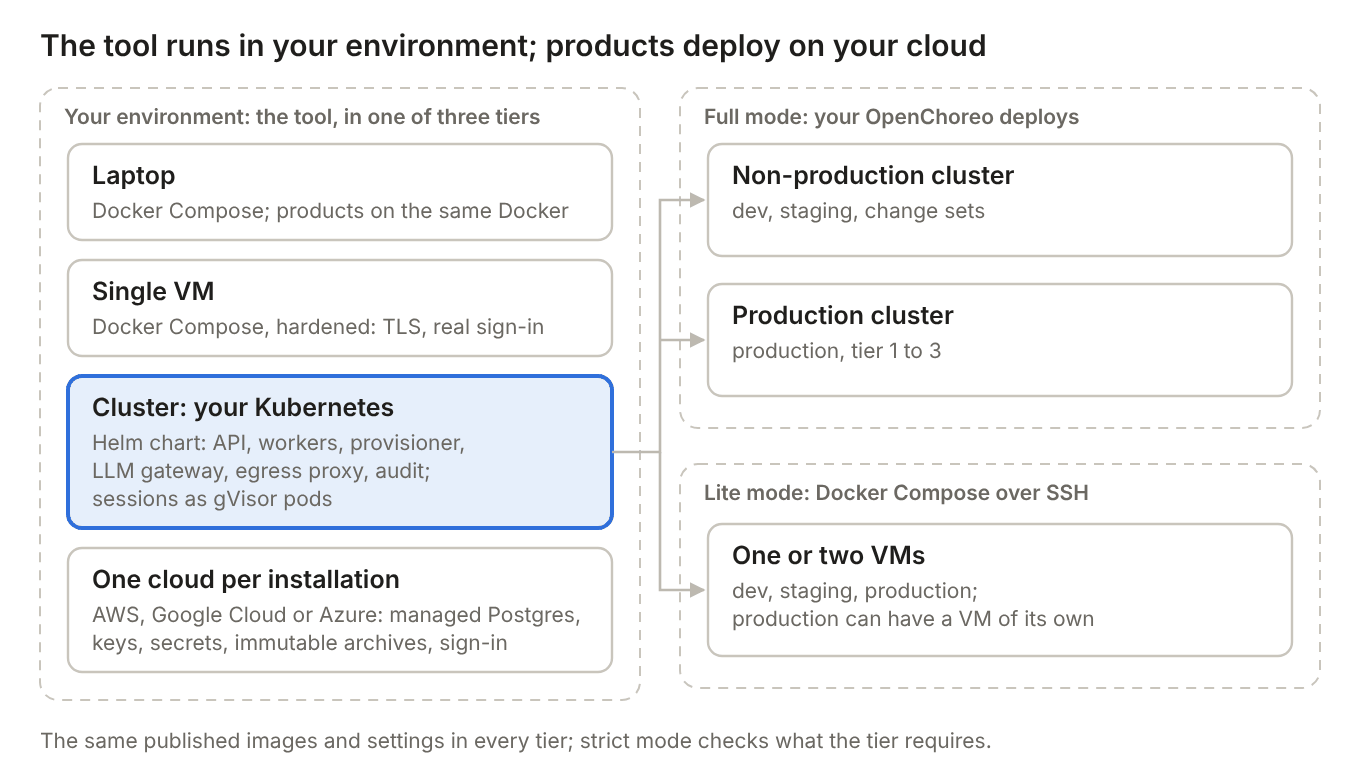
Your environment, three tiers (ADR 0007), all from the same published images and settings:
- Laptop: Docker Compose on one machine, for building with the tool end to end; development sign-in, products deploy to the same Docker.
- Single VM: Docker Compose, hardened, for small teams: TLS, real sign-in, sandboxed sessions and backups.
- Cluster: your Kubernetes, with the Helm chart: the API and workers, the provisioning worker, the LLM gateway, the egress proxy, audit Kafka and the sink, with agent sessions as gVisor pods in their own namespace.
One cloud per installation (ADR 0010): AWS, Google Cloud or Azure, set by VALXEL_CLOUD, supplies the managed Postgres, signing keys, secrets, immutable archives and sign-in, and runs every product the installation builds.
Products run in one of two modes, set per product in product.yaml (runtime.mode):
- Full mode: two Kubernetes clusters per product, registered with your OpenChoreo as data planes: non-production (dev, staging, change-set environments) and production. Managed databases come from the platform's cloud-neutral resource catalog. Each product picks a capacity tier from 1 to 3; every product's pilot stage is held to tier 3 (99.5%, 4-hour recovery, at most a day of lost data).
- Lite mode: for small products. Environments run as Docker Compose projects on one or two VMs, deployed over SSH through
ComposeRuntime, which implements the same interface as OpenChoreo, so gates, agents, the change log and incidents work the same. Production can have a VM of its own.
License: source-available under the Business Source License 1.1, free in production for individuals and for organizations under 250 people and $10M revenue; each release becomes Apache 2.0 three years after it is published.
Modes of the tool itself: live, where every integration reaches its real system, and offline (stub), deterministic for evaluation and tests. VALXEL_STRICT=1 refuses to start in production while anything would quietly fall back to a stand-in or an unsafe setting, checking what the tier requires.
Governance, change management and FinOps
Governance as code
- The platform's constitution (VX articles, such as VX-3 for human production, VX-7 for data-class routing, VX-16 for Kafka-first products and VX-17 for who may call whom) applies to every product.
- Each product's governance repo adds its own constitution and
product.yaml: repos, approver teams, budget, thresholds, high-risk paths, runtime, dependencies on shared services and workflow profiles. A product may tighten the platform's rules, never loosen them. - Pinning: a feature pins both by commit when it starts, so a rule change mid-flight can't change what was approved.
- Lessons: proposed as governance pull requests; once merged, pinned into prompts and the critic's checklist.
Change management
Every production change is recorded with what changed, who or what made it (a person at G6, or the tool under the remediation policy) and why. The record is hash-chained in the change log and gets a ServiceNow receipt where the product uses ServiceNow. Incidents correlate with recent changes, and look-backs read the same log.
Incidents
- Investigation: production signals join an open incident or open one; OpenChoreo's root-cause agent investigates while the tool correlates recent changes.
- Mitigation: when the policy allows and the analysis agrees, the tool turns off a recent flag or rolls back a recent release, and records it.
- Paging: on-call is paged urgently only if the tool can't act, its action fails, or the failure continues.
- Afterwards: the fix returns through the pipeline as a hotfix, and the postmortem is drafted into the governance repo.
FinOps
- Building cost: the usage ledger prices every model call by role, phase and feature, with cache hits.
- Running cost: OpenChoreo's FinOps data and your cloud's cost data give each feature's production cost, in a FOCUS-format ledger beside its build cost, compared with the cost plan approved at G4.
- Budgets: budgets per product stop agents when spent (an escalation), and the cloud's budget alerts arrive as production signals.
- Lite mode: the VM's price shared across environments and features by container CPU time (planned).
Security architecture
| Concern | Design |
|---|---|
| People | GitHub, Cognito, Google Workspace, Entra ID or any OIDC provider; revocable sessions, with deciders' identity re-checked every 4 hours; approval rights come from the teams or groups each product's governance names; separation of duties at gates; production needs a person (VX-3) |
| Agents | Sessions run sandboxed (gVisor) with no GitHub token, cloud credentials or model key; they reach only the LLM gateway and the egress proxy, whose allowlist and git broker let a coder push only to its one repo; hooks off, no package install scripts; documents and requests reach agents as marked untrusted content (threat model, ADR 0008) |
| GitHub | Two Apps: Delivery (no administration) for the API process, Provisioning (administration) for the provisioning worker only; each App's key stays in your cloud's key service, sign-only, and only its one identity may sign |
| Secrets | One secret store (your cloud's, or mounted files), scoped per product; key rings so every secret rotates without downtime; strict mode refuses published, weak or environment-held secrets |
| Data | The gateway routes health and payments work only to model providers covered for it (VX-7); products' services reach only what they declare (VX-17) |
| Webhooks | HMAC or bearer checks in constant time, accepting the current and previous secret during a rotation |
| Supply chain | Base images pinned by digest, Python packages by hash; product builds scanned, signed, with SBOMs and provenance; images deployed by digest |
| Audit | Gate decisions, production changes and sign-ins go to the audit sink and an immutable archive (Object Lock or locked retention), anchored by hash chains; the usage ledger and agent traces |
Rotation: 15 of the 22 secret kinds can rotate with no person involved, as pre-approved standard changes. A person steps in only where a provider's web console is the only way to make a key, for emergencies, and for a quarterly review: about 5% of the work.
Known gaps, each tracked: a package registry proxy with quarantine for agents' installs, an end-to-end install rehearsal on a real cluster, and an outside penetration test. The security packet keeps the current list.
Quality attributes, constraints and open items
| Attribute | How the design meets it |
|---|---|
| Durability | Every workflow step is checkpointed in Postgres; threads wait days for people, CI or deploys and resume after restarts |
| Scale | Stateless replicas behind a load balancer; an advisory lock per thread, an elected watcher for external waits, live updates over Postgres NOTIFY; coder agents fan out per task |
| Testability | The offline mode runs the whole pipeline deterministically in tests, and each cloud adapter passes the same conformance checks as its fake; evals replay past documents against a changed model, prompt or plugin pin, and a canary tries a config on some features first |
| Cost control | A cache-first prompt layout, model routing per role, budgets per product that hand work to a person when spent, and lite mode for small customers |
| Portability | One cloud per installation, AWS, Google Cloud or Azure, behind ports; the runtime is OpenChoreo or Docker Compose; three tiers from a laptop to a cluster; several model vendors |
| Maintainability | Layers enforced by a test (root, four seams, core), a lint ratchet that only goes down, and a module map generated from the code |
| Human share | Active minutes recorded at every decision; the pilot report measures it against the 15% goal |
Constraints: Python and LangGraph for the service, React for the web app, Postgres as the only database, GitHub for code and governance, OpenChoreo on Kubernetes for products in full mode, and one cloud per installation.
Open items
- First release: the first tagged release of the images and the Helm chart, then an install rehearsal on a fresh cluster.
- Package registry proxy: quarantine and age rules for agents' package installs.
- Lite mode, remaining parts: cost sharing across environments, design checks and monitoring on the VM.
- Parked: a trial of LangChain's agent harness against ours (ADR 0009).